
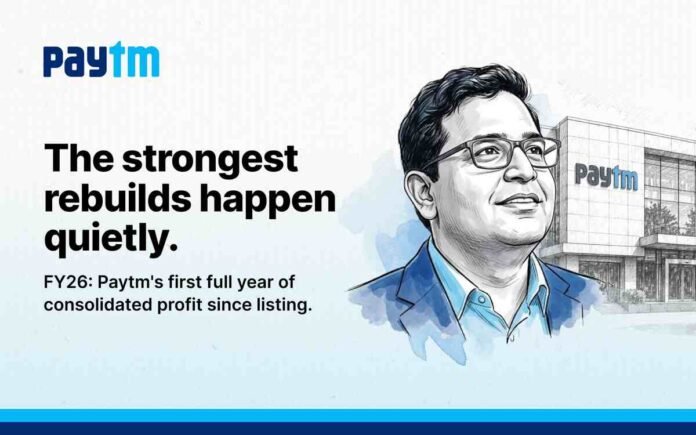
Dalal Street is beginning to look at Paytm differently. After two years of pressure, scrutiny and questions around sustainability, One 97 Communications, the parent company of Paytm, has closed FY26 with its first full year of consolidated profit since listing. The stock’s recent recovery has only sharpened that shift in perception.
The change is not only in the numbers. It is in the way the company is now being measured. A year ago, the market was asking whether Paytm could stabilise. Today, analysts are tracking payment margins, financial services growth, wealth, AI-led productivity and operating leverage.
Paytm reported revenue from operations of ₹8,437 crore in FY26, up 22% year-on-year. EBITDA stood at ₹502 crore, against a loss of ₹1,506 crore in FY25, marking a ₹2,008 crore improvement in one year. Profit after tax stood at ₹552 crore.
The rebuild has been quiet, but not accidental. Vijay Shekhar Sharma did not respond to the difficult period with loud pivots or public campaigns. The company instead tightened the operating engine. Marketing expenses fell from ₹508 crore in FY25 to ₹275 crore in FY26. Employee costs reduced to ₹2,765 crore from ₹3,288 crore. Other direct and indirect expenses narrowed to ₹1,418 crore from ₹1,695 crore.
That is the core of the Paytm story now: growth with discipline.
BofA described the quarter as an “operational leverage-led EBITDA beat” and said profitability remained resilient despite the loss of PIDF incentives and no UPI incentives. Jefferies called it “healthy core growth” and said margin expansion was being driven by “operating synergies”. It also said new payment and financial products across loans and wealth could support more than 20% revenue growth and EBITDA expansion over the next three years.
The March quarter showed why the market is paying attention. Revenue rose 18% year-on-year to ₹2,264 crore on a reported basis and 26% on a comparable basis, despite the discontinuation of PIDF and no UPI incentive payout. Paytm said it had already offset 30-40% of the PIDF impact during the quarter.
That matters because the key question for investors was not whether Paytm could grow in a favourable environment. It was whether the company could absorb incentive and regulatory shocks without losing operating momentum. The March quarter suggested that profitability is becoming less dependent on external support and more dependent on execution.
JM Financial said Paytm’s underlying growth remained “materially stronger” on a like-to-like basis, supported by GMV growth, structurally improving payment processing margins and continued scaling in financial services. Motilal Oswal said Paytm is progressing steadily toward “sustainable profitability”, backed by operating leverage and resilient GMV growth.
Mirae Asset called it a “resilient quarter” and said financial services remains a “high-growth and high-margin engine”, with AI-driven cross-sell providing a long runway for scalable, capital-light expansion.
The Paytm Payments Bank issue remains part of the public narrative, but the market appears to be separating it from the operating company’s performance. Paytm has maintained that the bank matter has no financial or business impact on the listed company. Analysts have also noted that commercial links between the listed company and the bank had already been terminated and the investment impaired. In that context, FY26 becomes more important: it shows the listed company growing after the disruption, not waiting for the disruption to disappear.
The business mix also looks broader than before. Payments continue to provide scale. Financial services distribution is adding higher-margin revenue. Wealth and commerce are emerging as newer growth areas. Together, these give Paytm more than one lever beyond its original payments franchise.
This is also why the market’s language around Paytm has changed. The company is no longer being seen only as a turnaround candidate. It is increasingly being assessed as a platform business where scale, distribution and cost control can convert into profit.
The next layer is artificial intelligence. During the earnings call, Sharma said AI agents would be a key focus area over the next 12 months as Paytm expands merchant and consumer offerings. The company has also highlighted AI-led product innovation and productivity as drivers of future margin expansion.
For Sharma, FY26 may be remembered as the year discipline became strategy. Paytm’s earlier identity was built around category creation: mobile payments, QR codes and Soundbox. Its new phase is being built around operating maturity.
The signal from FY26 is clear. Paytm’s rebuild was not driven by one dramatic move. It came through cost control, better execution, operating leverage and a sharper business mix. That may be less noisy than a turnaround headline, but it is exactly the kind of rebuild markets tend to reward.

